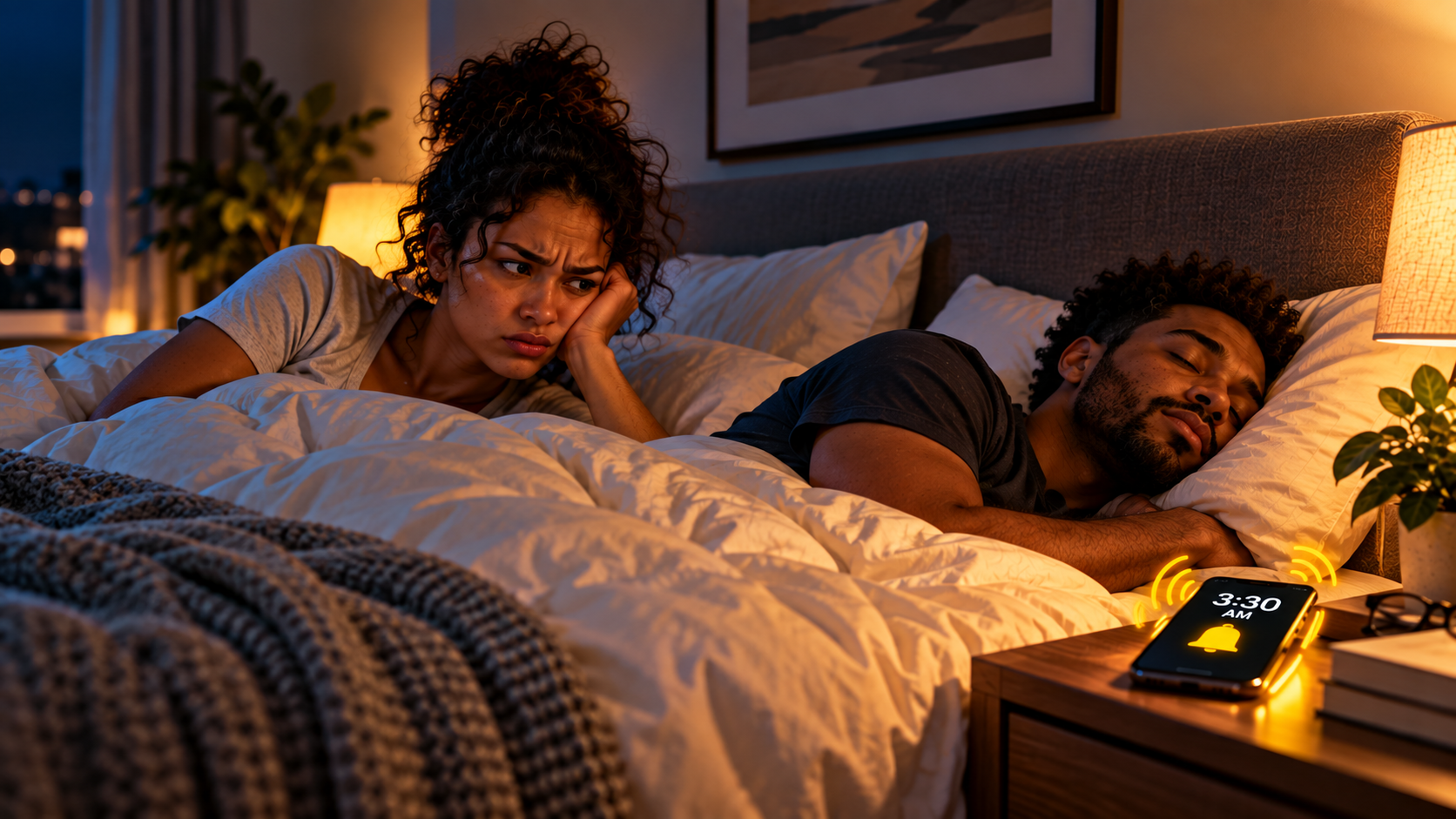
t goes off. They don't move. It goes off again nine minutes later. You are now fully, furiously awake at 3:39am next to a person sleeping the sleep of the untroubled.
Featured in this article
Morning's Light, Evening's Calm — Ritual Planner
Let's be honest about the rage, because it's disproportionate and everyone pretends otherwise.
You love this person. You would help them move house. And yet at 3:39am, listening to that ascending marimba for the second time while they breathe peacefully beside you, you are experiencing something close to a personality disorder. You are composing speeches. You are considering the window.
Then the third alarm goes. And here's the truly maddening part: they still don't hear it. You're the only person in this room being woken up by their alarm.
Good news — this is an extremely solvable problem, and the solution is not "be more tolerant" or "go to sleep earlier, somehow". It's a five-minute conversation had at a sensible hour, plus about twelve pounds of equipment.
They genuinely aren't hearing it (annoyingly)
First, let's remove the accusation, because it's the thing that turns a logistics problem into a row.
When you wake up, your brain doesn't switch on cleanly — it goes through sleep inertia, a groggy transitional state where you're technically awake and functionally useless. Deep in that state, an alarm can be processed, silenced and forgotten without any of it reaching memory. They will honestly tell you in the morning that it only went off once. They are not lying. They were simply not there.
You, meanwhile, were pulled out of sleep by a noise you didn't expect and couldn't switch off — the most disruptive kind of waking there is. So you remember all four.
One of you is being woken by an alarm. The other is being woken by someone else's alarm. Those are completely different experiences, and that gap is where all the resentment grows.
The snooze button has been unexpectedly vindicated
Now the plot twist, which is going to feel unfair.
You've been told all your life that snoozing is terrible for you. A 2023 laboratory study put that to the test: 31 habitual snoozers, half an hour of snoozing versus waking straight up. The result — thirty minutes of snoozing didn't harm sleep, mood or cortisol, and slightly improved cognitive performance right after waking. It also stopped people being dragged out of deep sleep: none of the snoozers woke from slow-wave sleep, compared with 30% of those who got up on the first alarm.
So your partner's habit may actually be doing something sensible for their brain. Infuriating, I know.
But read the study carefully and there's a gap you can drive a lorry through: it measured what snoozing does to the snoozer. It says precisely nothing about the person lying next to them who didn't consent to any of it.
Which is the whole argument, really. They're not wrong to snooze. They're wrong to snooze out loud.
The fixes, in order of how little effort they take
Start at the top and stop when it works
- A vibrating alarm on the wrist. The single best fix on this list. A cheap fitness band or watch buzzes silently on their arm. They wake; you don't. Most couples who try this never go back.
- Phone across the room, on the lowest volume that works. Kills the snooze cycle entirely, because getting up is now part of switching it off. Slightly brutal for them, enormously effective.
- Change the sound. A gentle, gradual alarm rather than a klaxon. Many phones have a slow-rising option — much less likely to jolt the innocent party awake.
- Earplugs and white noise for you. Foam earplugs cost almost nothing and are startlingly effective. A fan or white noise machine masks the sudden-noise problem, which is the bit that actually wakes you.
- The one-alarm rule. If they genuinely need multiple alarms, that's a sign the wake time isn't realistic for their bedtime. That's a scheduling conversation, not an alarm conversation.
- Different rooms, some nights. More on this below — it's far more common and far less dramatic than people think.
Have the conversation at 8pm, never at 3:39am
This applies to every household conflict, but it applies double here, because a person woken at 3:39am is not a person capable of diplomacy. Anything said at that hour comes out as an accusation and gets received as one.
So raise it at a completely unrelated time, when you're both fine and nobody's tired, and make it a logistics problem rather than a character flaw:
The alarm agreement
"Your alarm wakes me and then I'm up for the day. Can we try a vibrating one for two weeks and see?"
Notice: no "you always", no "you don't care", no mention of the fourteen previous mornings. One problem, one proposal, one trial period. Almost nobody says no to a two-week experiment — and almost nobody argues with "I can't get back to sleep afterwards", which is a fact rather than a complaint.
The schedule problem underneath the alarm
Often the alarm is just where a bigger mismatch shows up.
One of you starts at five and is asleep by nine. The other is properly awake until midnight. You are, biologically, on different clocks — and a fair number of couples are trying to run two incompatible schedules through one bedroom without ever discussing it as a thing that needs designing.
Worth mapping once, on paper, the way you'd map anything else in the household:
- What time does each of you actually need to be up? Not aspirationally. Actually.
- What time would each of you naturally fall asleep? Genuinely, without willpower.
- Where's the collision? It's usually one end — the early riser's alarm, or the night owl coming to bed.
- What are the quiet hours? After this time: no lights, no phone brightness, no wardrobe rummaging. Agreed in advance, so it's a rule rather than an accusation.
Small one that resolves a surprising amount: the early riser lays everything out the night before, in another room. Clothes, bag, keys. Then the morning involves leaving quietly rather than assembling an outfit in the dark next to a sleeping person.
On sleeping in separate rooms
Time to say this plainly, because a lot of people treat it as a relationship failure and it very much isn't.
In a 2023 survey by the American Academy of Sleep Medicine, more than a third of Americans said they occasionally or consistently sleep in another room to accommodate a bed partner — 45% of men, 25% of women, and 43% of millennials, the highest of any generation.
More than a third. That's not a crisis, that's a common household arrangement that people simply don't announce at dinner parties.
And the logic is hard to argue with. Two people who sleep properly are kinder, funnier and more patient with each other than two people running on broken sleep in the name of togetherness. It doesn't have to be permanent, either — plenty of couples do it on weeknights and share a bed at weekends, or only during a stretch of early shifts.
The thing that makes it work is talking about it as a sleep decision, agreed by both, rather than one person silently relocating after a row. Same arrangement, completely different meaning.
When it's not the alarm at all
One genuinely important note to end on.
If the problem isn't really the alarm — if it's loud snoring, or if you've noticed them stopping breathing, gasping or choking in their sleep, or they're exhausted all day despite plenty of hours in bed — that's worth a doctor's appointment rather than a pair of earplugs. Those can be signs of obstructive sleep apnoea, which is common, very treatable, and matters well beyond anyone's sleep quality.
The sleep specialists who ran that survey make the same point: separate rooms are a reasonable arrangement, but they shouldn't be used to quietly work around snoring that ought to be looked at. Muffling the symptom is not the same as dealing with the cause.
Otherwise — get the vibrating alarm, agree the quiet hours, buy the earplugs, and reclaim your 3:39am. You'll both be considerably nicer people for it.
The five-minute fix
- Raise it at a neutral hour, as one problem with one proposal and a two-week trial.
- Try a vibrating wrist alarm first. It solves this for most couples outright.
- Phone across the room, gentler sound, earplugs and white noise for whoever's being woken.
- Map both schedules once and write down the agreed quiet hours.
- If snoring, gasping or all-day exhaustion is in the picture, book the doctor rather than the earplugs.
Sources
- Sundelin, T., Landry, S., & Axelsson, J. (2024). Is snoozing losing? Why intermittent morning alarms are used and how they affect sleep, cognition, cortisol, and mood. Journal of Sleep Research, 33(1).
- American Academy of Sleep Medicine (2023). Over a third of Americans opt for a "sleep divorce".
Our household planners have a routines page for exactly this sort of thing — agreed quiet hours, morning run-throughs and who's up when, written down instead of argued about. Browse the planners →
Planners for this article
Morning's Light, Evening's Calm — Ritual Planner
Design mornings and evenings that work for two different body clocks — wind-down, wake-up and the space between.
ViewThe Anchored Day
ViewThe Reset — A Fresh-Start Wellness Planner
ViewPlan it in Arwign Calendar
Written by
David @Arwign
Writes for Arwign Planners about the systems, science and small habits behind a calmer, more intentional life.
Explore our planners


Comments (0)
Sign in to join the conversation.
Be the first to comment.